Tactical duffel backpack with two shoulder straps
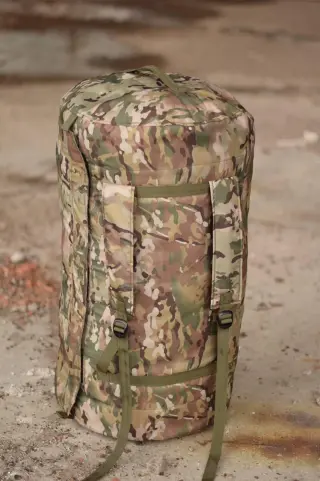
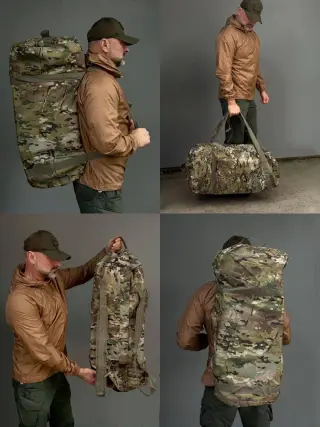


Tactical duffel backpack for relocation, rotation and travel
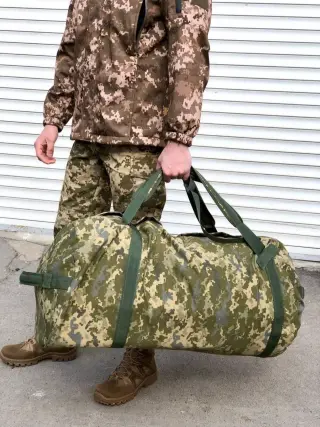
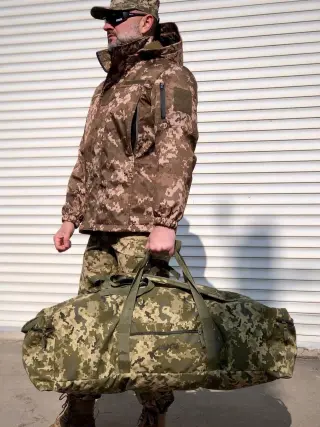
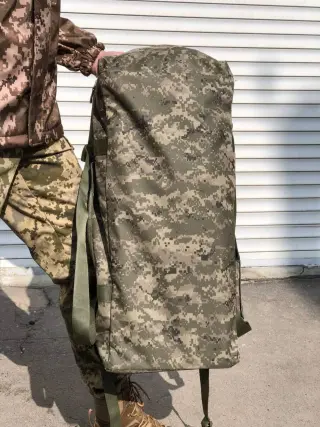
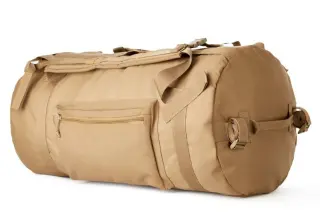
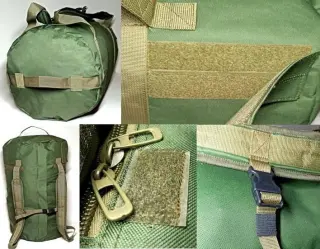
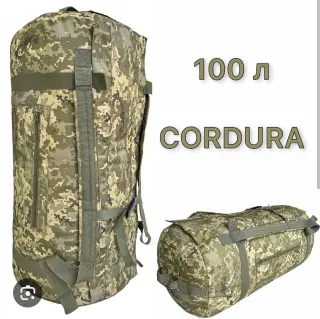
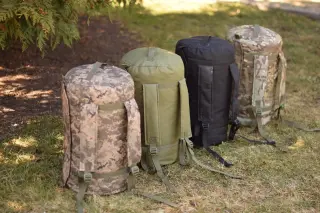
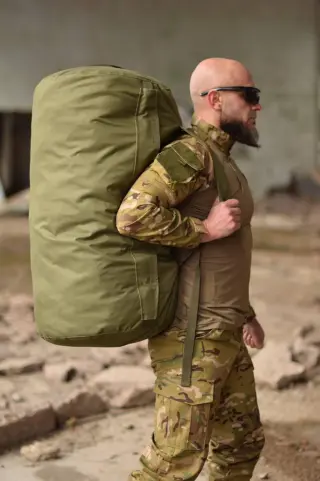
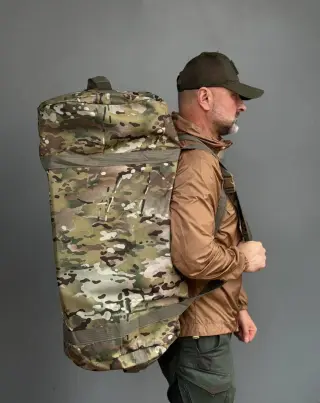
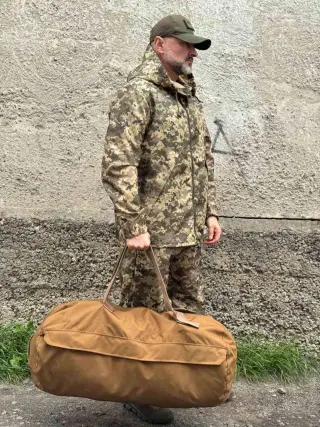
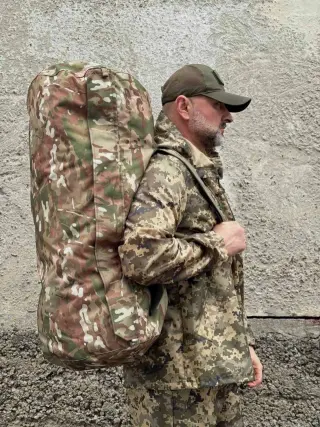
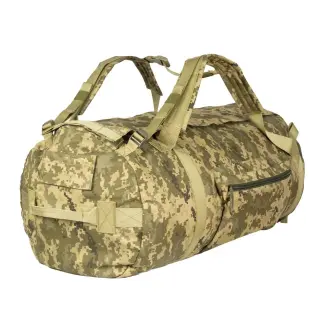
A duffel backpack is a large-capacity cylindrical bag with two shoulder straps and a carry handle, so you can carry it both on your back and in your hand. This kind of duffel is chosen when you need to move a lot of gear in one go: for redeployment, rotation, training or a long trip. Unlike a regular duffel with handles or a shoulder strap, a backpack duffel frees up your hands and makes it easier to change from one vehicle to another. Prices range from 960 to 3 220 UAH, and you can find other formats among duffel bags and transport bags.
Which capacity to choose
Capacity determines not only how much gear will fit, but also whether you will be able to lift it. A fully packed large duffel is heavy, and it is usually weight, not space, that becomes the limit. So choose a capacity based on your actual set of gear with a small reserve, rather than "just to be sure it all fits".
| Capacity | Who it suits | What to consider |
|---|---|---|
| 35 L | Short trip, an extra bag alongside your main backpack | Only the bare essentials will fit |
| 65 L | Personal items for a longer trip | A sleeping bag will take up a significant part of the space |
| 100–110 L | Main duffel for relocation with a sleeping bag and clothing | Hard to carry for long when full |
| 120 L | Maximum gear in one carry, winter kit | Bulky in cramped transport |
For reference: the "Tactical duffel backpack 35 L Oxford 600D" model measures ⌀29/L55 cm, while 120 L models made of Oxford 600D measure ⌀44/L85 cm. A long duffel on your back can hang below your lower back and get in the way when getting into a car, so shorter people should take this into account in advance.
How to carry it on your back and in your hand
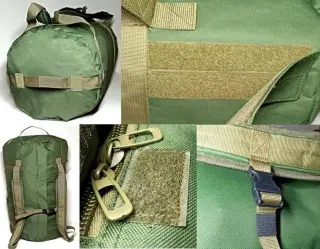
The straps of a duffel backpack are not a full suspension system like on a hiking backpack: there is usually no rigid back panel or hip support, so all the weight rests on your shoulders. That is enough to carry gear from the car to the accommodation, but not for a many-hour march. Before setting off, tighten both straps so the duffel sits snugly against your back and does not sway.
Put heavy items closer to your back and toward the middle, and soft ones — a sleeping bag, clothing — along the edges: this way the cylinder keeps its shape and does not pull backward. Use the handle for short distances and when loading into a truck bed or luggage compartment. Give preference to soft adjustable straps: a narrow hard strap quickly chafes the shoulders under a full load.
Fabric, zipper and moisture protection
Such duffels are usually sewn from reinforced nylon, Oxford 600D or Cordura, and Cordura 1000D is also found. Cordura withstands abrasion against truck beds, concrete and rocks better, while Oxford is lighter. If the duffel will often be dragged along the ground and tossed into vehicles, the tougher fabric will pay off.
The fabric is coated with a water-repellent finish, but a tactical duffel backpack is not completely waterproof: under prolonged rain, water seeps through the seams and zipper. Pack items that must not get wet in a dry bag or sturdy plastic bags. Also consider the zipper type: a lengthwise zipper, as on the "Tactical duffel backpack 100 L with full-length opening pixel" model, lets you reach any item without unpacking the whole contents.
Frequently asked questions
Can I carry a duffel backpack every day instead of a regular backpack?
You can, but it is inconvenient for daily walks and hikes. A single large compartment with no organization makes it harder to find small items, and the straps are designed for short carries. For everyday carry, an assault or city backpack is a better choice.
Will a sleeping bag fit in the duffel?
Yes, the cylindrical shape is exactly designed for items of various shapes: a sleeping bag, a small sleeping pad, clothing and gear. In a 100–120 L duffel, a sleeping bag leaves enough room for other items, while in a 35 L duffel it will take up almost the entire volume.