Trekking Poles for Hiking and Nordic Walking



Trekking Poles for Hiking and Nordic Walking
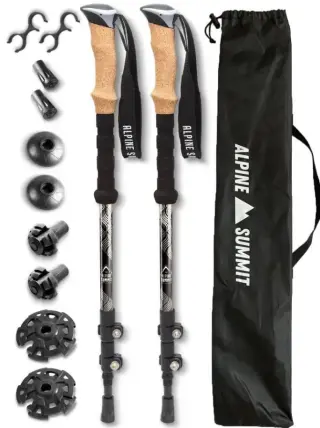
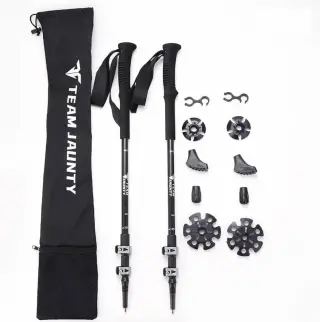
Trekking poles give you two extra points of support. On a steep climb you pull yourself up with your arms, on a descent you brake with them, and on wet rock or snow it is easier to keep your balance. They are used on mountain hikes, on forest trails and for Nordic walking in the city. These poles are sold as a pair, all of them have three sections, and replaceable tips and a carrying case are included. You can find the rest of your camp gear in the camping equipment category.
Telescopic or folding?
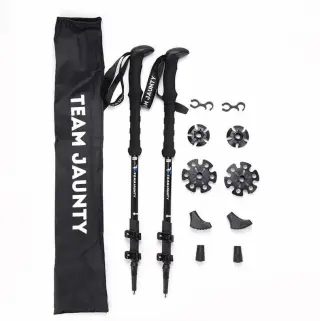
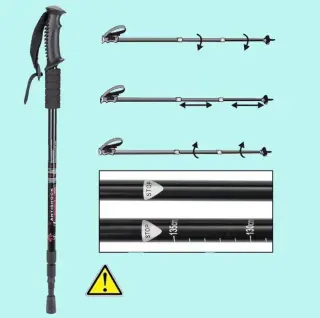
Telescopic poles are adjusted by extending the sections, so you can easily change the length right on the route: shorter on the ascent, longer on the descent. Pay attention to the locking mechanism. An external clamp is visible and easy to tighten, while a double lock, as on the TEAM JAUNTY 7-3JWS, adds extra protection against the sections slipping.
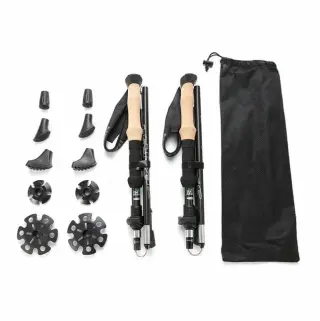
Folding poles with an internal cord assemble like a tent pole and are shorter when collapsed. The TEAM JAUNTY 7075 AL folds down to 37 cm, so it fits in a backpack. The downside is a narrower adjustment range, so it is worth trying this model for your height in advance.
Aluminum or carbon, and which grip to choose
The 7075 aluminum alloy in the TEAM JAUNTY 7075 AL, 7-3JWS and both ALPINE SUMMIT models handles side impacts well: under heavy load it will bend rather than break. The carbon TEAM JAUNTY T-3JWS are lighter, so your hands get less tired over a long day. However, carbon fiber does not like knocks against rocks and breaks abruptly.
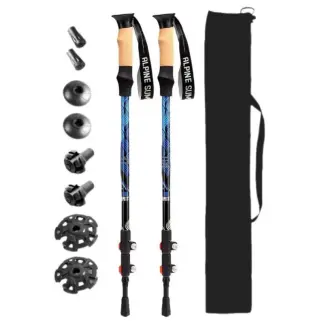
The grip affects comfort no less than the material. The cork on the ALPINE SUMMIT slips less in a sweaty palm and does not feel cold in frost. EVA foam is light and soft, and the wooden insert on the TEAM JAUNTY 7075 AL is a matter of taste and of getting used to the grip.
Why shock absorption and replaceable tips matter
Spring shock absorption in unbranded telescopic poles softens the jolt when the pole hits hard ground or asphalt. When walking fast on flat terrain this is noticeable, but on a climb the spring absorbs part of the push-off force.
Tips are swapped depending on the surface: rubber caps for asphalt, so the pole does not clatter or slip, wide snow baskets for snow and mud, and the bare tip for soil and rocks. Do not walk in the city without rubber caps: the tip wears down quickly and slips on paving tiles.